

Bernie's Photo
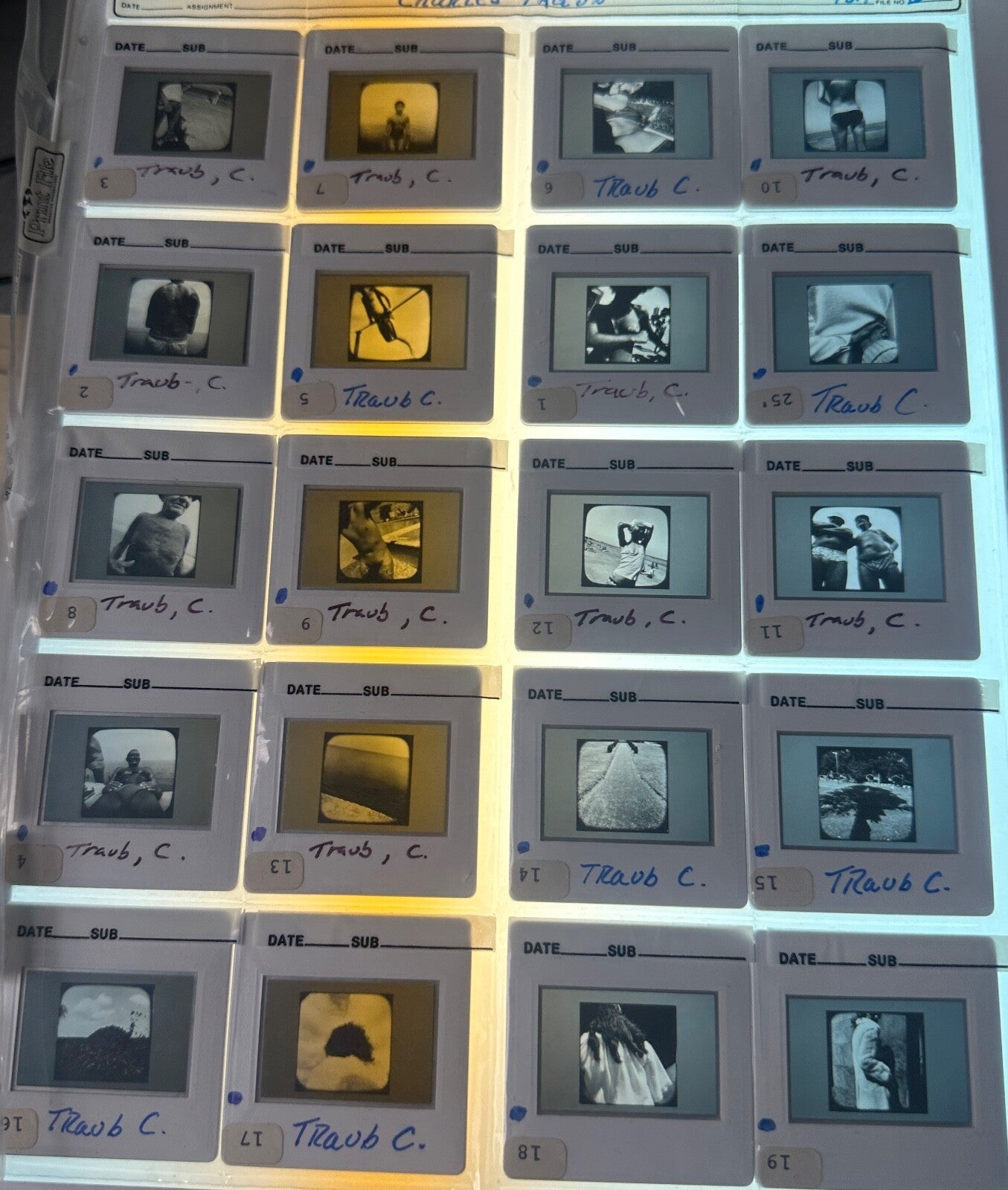
Professional Photographers "Charles Traub" 35mm Slides Lot of 25
Professional Photographers "Charles Traub" 35mm Slides Lot of 25
Couldn't load pickup availability
Charles H. Traub (born April 6, 1945) is an American photographer and educator, known for his ironic real world witness color photography. He was chair of the photography department at Columbia College Chicago, where he established its Museum of Contemporary Photography (MOCP) in 1976,[1] and became a director of New York's Light Gallery in 1977.[2] Traub founded the MFA program in Photography, Video, and Related Media at the School of Visual Arts in New York City in 1987, which was the first program of its kind to fully embrace digital photographic practice.[3] He has been Chairperson of the program since. Traub has published many books of his photographs and writings on photography and media.[4]
Early life and education
[edit]Born and raised in Louisville, Kentucky, Traub earned his BA in English literature at the University of Illinois, where both his mother and father had also attended. In 1967, during his last semester of his senior year in college, he took his first photography class with the landscape photographer Art Sinsabaugh using the camera left to him by his recently deceased father. His family roots in both central Illinois and Kentucky gave inspiration for his early photographic work.[5]
After college, Traub joined the Peace Corps in Ethiopia. He married a fellow Peace Corps member, who died shortly after arriving in Ethiopia. Traub himself was injured and returned home where he met fellow Kentuckian, Ralph Eugene Meatyard, who became an important inspiration and friend. Although he enrolled in a graduate program in humanities at the University of Louisville, he was drafted into the United States Army as an infantryman but was subsequently discharged for medical reasons incurred during his time with the Peace Corps.[5]
After service in the United States Army in 1969, Traub decided to pursue photography at the Chicago Institute of Design. There he earned his Master of Science studying under Aaron Siskind, Arthur Siegel and Garry Winogrand. During this time, he began to experiment with different formats and processes in his landscape photographs of Kentucky, Indiana, and Illinois. He has said "You probably recognize the similar sentiment that exists in all of those earlier pictures; they all share a certain kind of Southern Gothic, dark, and maudlin sensibility."[6] His thesis of haunting, abstracted black-and-white positive and negative landscapes, "Edge to Edge", was widely exhibited, and featured in a solo show at the Art Institute of Chicago (1975).[7]
Career
[edit]Following his landscape work Charles Traub made three well-known series of black-and-white photographs: Street, Parties, and his first monograph, Beach, all used an innovative vignette on a Rolleiflex SL66.
In 1971 Traub began teaching full-time at Columbia College Chicago, and was responsible of developing new curriculum for the growing public interest in the medium. He was instrumental in developing the school's Contemporary Trends Lecture Series that celebrated renowned international photographers and image-makers. Subsequently, he became chairperson of the department and founded the Chicago Center for Contemporary Photography, which became the Museum of Contemporary Photography (MOCP). In 1973, along with his colleague Douglas Baz, Traub went on a sabbatical to make the Cajun Document, extensive look at the culture of the Louisiana bayous. Traub's first major body of work in color, Street Portraits, began in 1976, continued after his move to New York City shortly thereafter, and culminated in his monograph Lunchtime.
His move to New York was followed by his first solo exhibition of photographs at the Light Gallery. Its owner, Tennyson Schad, then hired Traub to become director of this prestigious gallery. Traub curated numerous exhibitions there, including The New Vision: Forty Years of Photography at the Institute of Design; Aaron Siskind's Harlem Document; Designed for Photography; and The Color Work of the FSA. Traub also showcased major photographers new to the gallery: William Klein, Luigi Ghirri, Ray Metzker, Mario Giacomelli and Louis Faurer among others. During this time, he attempted to connect the communities of photographers and artists working in other media.[6]
After leaving the gallery in 1980 he continued his personal work and formed the Wayfarer partnership with Jerry Gordon���a specialized editorial and corporate photography agency. Their work was featured in many magazines, including Life, Time, Forbes, Fortune, Business Week, New York and Avenue as well as annual reports for Fortune 500 companies. Throughout the 1980s Traub traveled to Italy, Brazil, Haiti, Morocco and the Far East for his personal work. Dolce Via and In the Still Life are compendiums of photographs from that period.
In 1987 Traub was asked to design a graduate studies program for the School of Visual Arts, which became the MFA Photography, Video and Related Media Department. Since its inception, the program has been distinguished for its innovative use of digital technology, the inclusion of all aspects of the lens and screen arts and its internationally celebrated faculty. As an early advocate of the power of digital photography, Traub adapted it to his own practice. His philosophy about the importance of digital thinking is reflected in the manifesto Creative Interlocutor and the textbook In the Realm of the Circuit. Creative projects that highlight Traub's integration of new technologies include the interactive website Still Life in America and the iBook No Perfect Heroes: Photographing Grant.
Here is new york: a democracy of photographs was co-founded by Traub and three others.[8][9] This living memorial to the tragedy of 9/11 received the Brendan Gill Award as well as the ICP Cornell Capa Infinity Award. It is considered one of the seminal examples of crowdsourcing, digital production and online distribution of universally produced imagery. The exhibition traveled to 42 venues worldwide, and with its Web presence is considered to be one of the most widely viewed exhibitions of all time.[10]
Traub has dedicated himself to photographic education, and has been a chairperson at the School of Visual Arts for 30 years. He has served on a number of non-profit educational boards, and is the president of the Aaron Siskind Foundation. He has had more than 60 major exhibitions in galleries and museums throughout the world, including one-person shows at the Art Institute of Chicago, The Speed Museum, Hudson River Museum and Historic New Orleans Collection. Traub's work is in the permanent collections of more than two dozen major museums worldwide.
Publications
[edit]- Taken By Design: Photographs From the Institute of Design, 1937���1971, edited by Charles H. Traub, Art Institute of Chicago, 1971
- Chicago: The City and its Artists 1945���1978, University of Michigan Museum of Art, 1987
- Charles Traub: Beach, Horizon Press, 1978 (monograph)
- The New Vision: Forty Years of Photography at the Institute of Design, Introduction by John Grimes, Aperture, 1982[11]
- New York City Youth: An Intimate Portrait, Summer Jobs, (with Jerry Gordon), 1987
- Italy Observed In Photography and Literature, co-edited by Charles H. Traub, Preface by Umberto Eco, Rizzoli, 1988
- Aaron Siskind: Roadtrip Photographs 1980���1988, 1989
- Three Decades of Midwestern Photography: 1960���1990, Davenport Museum of Art, 1990
- An Angler's Album: Fishing in Photography and Literature, edited by Charles H. Traub, Rizzoli, 1990
- Creative Interlocutor, written by Charles H. Traub, 2000
- Here is New York: A Democracy of Photographs, co-edited by Charles H. Traub, Scalo, 2002
- In the Realm of Circuit: Computers, Art, and Culture, Textbook co-authored with Jonathan Lipkin, Pearson Prentice Hall, 2003
- In the Still Life, Introduction by Luigi Ballerini, The Quantuck Lane Press, 2004 (monograph)
- The Education of a Photographer, co-edited with Steven Heller and Adam B. Bell, Allworth Press, 2006
- Charles H. Traub, Introduction by Marvin Heiferman, Gitterman Gallery, 2006 (monograph)
- Object of My Creation: Photographs 1967���1970, photographs and text by Charles H. Traub, Gitterman Gallery, 2011 (monograph)
- Dolce Via: Italy in the 1980s, Introduction by Max Kozloff, Dialogue by Luigi Ballerini, Damiani, 2014 (monograph)
- Vision Anew. Co-edited by Adam Bell, University of California Press, 2015
- Lunchtime, photographs and text by Charles H. Traub, Damiani, 2015 (monograph)[12]
- No Perfect Heroes: Photographing Grant, interactive iBook, Interlocutor Press, 2016
____________________________________________________________
We sell a variety of used antiques. We do our best to accurately describe our images and
any flaw or defect we find. If you come across any info or issues that we have overlooked,
please contact us.
Make sure you have seen all shipping options for purchasing.
____________________________________________
**** We do not accept returns on any image of any kind ***** unless it's our mistake
SHIPPING
We use USPS & UPS for domestic and international along with standard international from ebay
We ship within 1-3 business days from receiving payment.
Tracking numbers are automated by eBay for each order when the shipping label is made
In the event of a return, shipping charges are not refundable unless the item is not as presented and the item is not described as an "As-Is" sale.
CUSTOMS
CUSTOMS MAY ADD additional costs upon delivery to your country.
These charges are normally collected by the delivery company or when you pick the item up.
PLEASE DO NOT confuse them for additional shipping charges.
Please contact us through eBay with any questions. THANKS FOR LOOKING!
Share